What Is Gold Vermeil? How It Differs From Plated and Gold-Filled
Gold vermeil (say “ver-MAY”) is sterling silver covered in a real layer of gold. In the US, the Federal Trade Commission’s Jewelry Guides say a piece can only be called vermeil if the base is sterling silver and the gold is at least 10 karat and at least 2.5 microns thick everywhere. That makes it much thicker than ordinary gold plating, and much cheaper than solid gold.
That’s the short answer. The rest of this guide explains what those numbers mean, how vermeil compares to the other words you’ll see on a product page, and how to check whether a seller’s claim holds up.
The legal definition, in plain words
The rule lives in section 23.4 of the FTC Jewelry Guides (16 CFR Part 23). Strip out the legal phrasing and it asks for three things:
- The base is sterling silver. Sterling means 92.5% pure silver. You’ll often see it stamped “925”.
- The gold is at least 10 karat. Karat measures purity out of 24. 10K is about 42% gold; 14K is about 58%; 18K is 75%.
- The gold is at least 2.5 microns thick, throughout. Not on average. Not only on the front. On all significant surfaces.
A micron is a thousandth of a millimetre. So 2.5 microns is thin in absolute terms, roughly a fortieth of the thickness of a sheet of printer paper. But in the world of gold coatings, it’s the thick end. Standard gold electroplate only has to be 0.175 microns.
The Guides also say that if there’s a layer of a base metal, such as nickel, between the silver and the gold, the seller should disclose it. Some factories use a nickel layer to help the gold bond. It’s worth asking about if your ears are fussy. We wrote a separate guide on earrings for sensitive ears if that’s you.
Vermeil vs gold plated
“Gold plated” is the broad, loose term. It means a layer of gold over another metal. That other metal is usually brass or copper, sometimes steel. The gold layer is often far thinner than vermeil’s.
The FTC Guides do set some floors:
- Gold electroplate: at least 10K gold, at least 0.175 microns thick.
- Heavy gold electroplate: at least 10K gold, at least 2.5 microns thick.
- Gold flashed or gold washed: less than 0.175 microns. Basically a tint.
So the real differences between vermeil and most plated jewelry are two:
- The base metal. Vermeil sits on sterling silver. Plated pieces usually sit on brass or copper, which can turn skin green and may contain nickel.
- The thickness. Vermeil requires 2.5 microns. A lot of plated jewelry is at or near the 0.175-micron floor, or below it if it’s labelled “flashed”.
What that means day to day: when the gold eventually wears through on vermeil, you see silver. When it wears through on cheap plating, you see brass.
Vermeil vs gold-filled
Gold-filled is a different method, covered in section 23.3 of the Guides. Instead of plating, a sheet of karat gold is bonded to a base metal (usually brass) with heat and pressure. To be called gold-filled, the gold must make up at least one-twentieth of the total metal weight, and the karat must be stated, as in “14K gold filled” or “1/20 14K G.F.”
Gold-filled usually has more gold by weight than vermeil. It tends to last a long time with daily wear. The trade-offs:
- The base is brass, not silver.
- It’s harder to make delicate or sculptural shapes, so styles lean simple: chains, wire hoops.
- If you see “rolled gold plate”, that’s the same method with a thinner ratio.
Neither is “better”. Gold-filled is a strong choice for chains and wire you’ll wear hard every day. Vermeil gives you a precious-metal core and more freedom in shape.
Vermeil vs solid gold
Solid gold means the piece is karat gold all the way through. A 14K hoop is 14K at the surface and at the core. It doesn’t wear through, because there’s nothing underneath to reveal. It also costs several times more. For the same style, you’re often looking at hundreds of dollars more, sometimes much more.
One thing to know: the Guides say a hollow piece shouldn’t be called “solid gold”. Hollow karat gold is real gold, but less of it.
If you want one pair of earrings for the next thirty years and never want to think about it, solid gold is the honest answer. Vermeil is for people who want real gold on the surface and silver underneath, at a price where owning three pieces makes more sense than owning one.
Quick comparison
| Base metal | Gold layer | What shows when it wears | |
|---|---|---|---|
| Gold vermeil | Sterling silver | 10K+, 2.5 microns minimum | Silver |
| Gold electroplate | Usually brass or copper | 10K+, 0.175 microns minimum | Brass or copper |
| Gold-filled | Usually brass | 10K+, at least 1/20 of the weight | Brass, after a long time |
| Solid gold | Gold | All of it | Nothing to wear through |
Is vermeil real gold?
Yes. The surface is real karat gold, at least 10K by law. It is not solid gold, and nobody selling vermeil should imply it is. Think of it as real gold, real silver, honest proportions.
How long does vermeil last?
It depends on how you wear it. Rings and bracelets rub against everything and wear fastest. Earrings and necklaces have an easier life. Water, soap, chlorine, sweat and lotions all speed things up. We wrote a full, honest answer to whether you can shower in gold vermeil, including the care routine we follow.
How to check a seller’s claim
The word “vermeil” is easy to type. Here’s how to see if the claim is real.
- Look for the micron number. A seller who meets the 2.5-micron rule usually says so. If the listing only says “vermeil” and gives no thickness, ask.
- Look for the karat. Vermeil must be 10K or higher. A listing should be able to tell you which.
- Look for “925” or “sterling silver”. If the base is described as “brass” or “alloy”, it isn’t vermeil, whatever the title says.
- Ask about a nickel layer. If there is one, the Guides say it should be disclosed.
- Ask for the plating report. A reputable maker can share a supplier test or thickness measurement. If the answer is vague, that’s an answer.
- Be wary of “18K gold vermeil” at very low prices. Silver and gold both cost real money. A very low price with big claims deserves a second look.
Where we stand
We make gold vermeil jewelry, so weigh what follows with that in mind. Every piece we sell is 925 sterling silver with at least 2.5 microns of gold, nickel-free. We’ll publish our supplier’s plating report on Our Gold so you can check the number yourself.
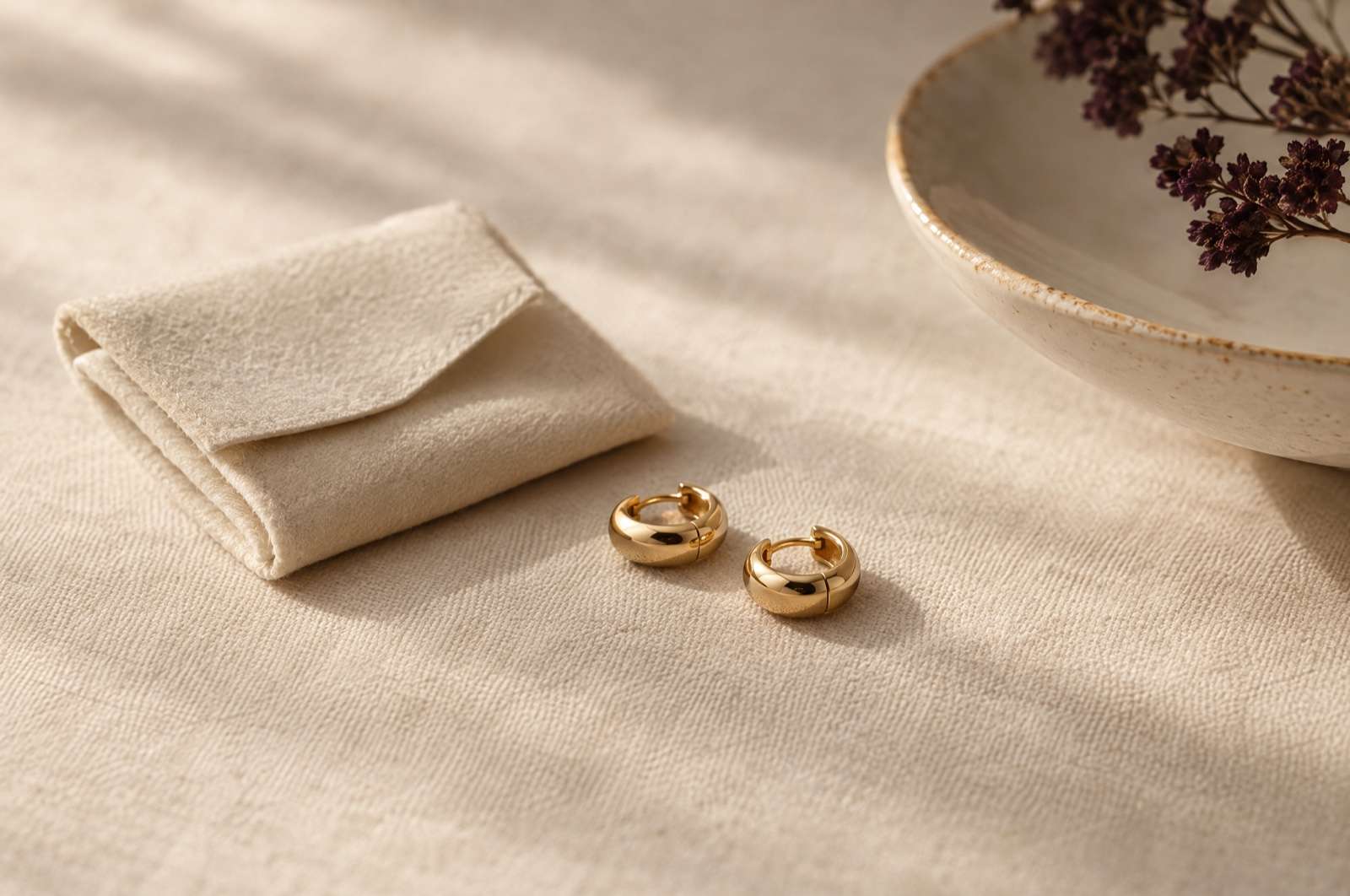
Our Dome Hoop is a 20 mm hollow dome with a hinged closure. It’s the piece we’d point to if you want to see what vermeil looks like on a bolder shape.
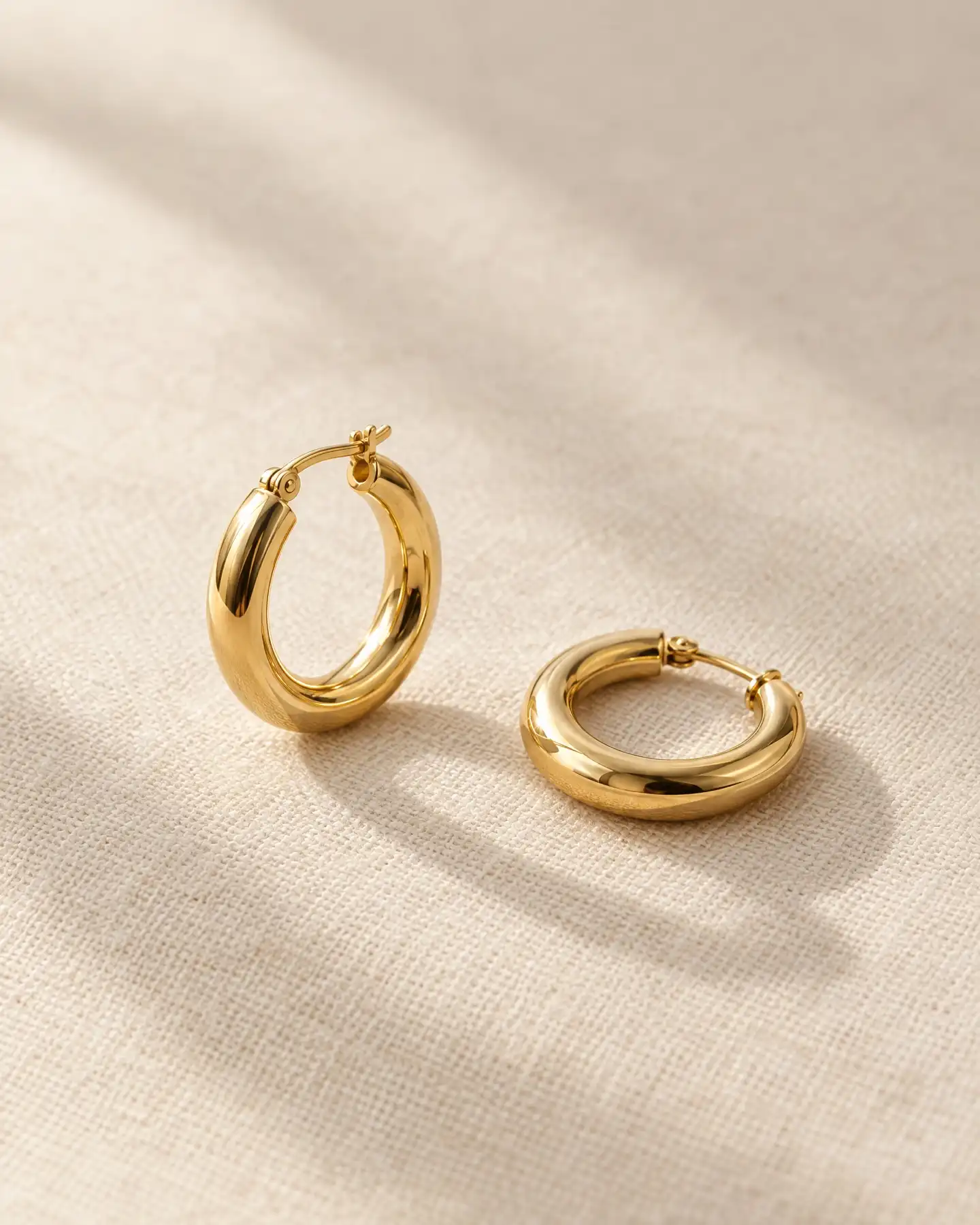
The Dome Hoop
A bold, hollow dome that is lighter than it looks. The pair you reach for with a white shirt and with a black dress.
$78 Pre-order · $0 today · ships by Feb 12
See the Dome HoopWho it’s not for: if you want something you never have to take off, look at solid gold. If you have a known allergy to silver or gold, vermeil isn’t the fix, and a dermatologist is the right first stop.
You can browse the full range in our gold vermeil jewelry collection. Everything is a pre-order right now: $0 today, charged only when it ships by February 12, 2027. The pre-order FAQ covers the details.
Sources
- 16 CFR Part 23 (FTC Jewelry Guides)
- FTC: Guides for the Jewelry, Precious Metals, and Pewter Industries
How we research and update articles: editorial standards. First published November 9, 2026.